SQLAlchemy
Python library for database interaction through object-oriented and SQL-based approaches
- Vendor
- SQLAlchemy authors
- Also known as
- sql-alchemy, sqlalchemy
Available worldwide
What is SQLAlchemy?
A Python-based database toolkit offering both an Object-Relational Mapper for domain-driven development and a SQL construction system for direct database interaction, supporting multiple database backends.
SQLAlchemy pricing
We don't have SQLAlchemy's full plan breakdown yet (its pricing page resisted automated reading). Here's what we could confirm. Always check live pricing for exact numbers.
What SQLAlchemy does
The capabilities that matter for orm & database tools, normalised so it lines up with every alternative. “-” means we haven't confirmed it, not that it's missing.
- Type-safe queries
- ✓
- Schema migrations
- ✗
- Relations / joins API
- ✓
- Languages
- Python
- Schema-first modelling
- ✓
- Raw SQL escape hatch
- ✓
- Multiple database backends
- ✓
- Connection pooling
- ✓
- Data browser / studio
- ✗
Platform & deployment
Independently observed- Self-hosted
Integrations (6)
Independently observed- PostgreSQL
- MySQL
- Oracle
- SQL Server
- SQLite
- Alembic
Security & compliance
Known vulnerabilities: 3 (0 in the last 12 months), max severity CRITICAL sourcea count reflects scale & disclosure, not quality
SQLAlchemy FAQ
Common questions about SQLAlchemy, answered from independent, dated evidence.
What is SQLAlchemy and what problem does it solve?
SQLAlchemy is a Python library that provides both an Object-Relational Mapping (ORM) layer and a SQL expression toolkit for interacting with relational databases. It abstracts away low-level SQL details, allowing developers to work with database objects as Python classes and manage database queries programmatically rather than writing raw SQL strings. This approach reduces code repetition, improves maintainability, and makes database interactions more Pythonic.
Source: https://www.sqlalchemy.org
Is SQLAlchemy free and open-source?
Yes, SQLAlchemy is completely free and open-source, distributed under the MIT license. There are no licensing fees, commercial tiers, or restricted versions - the software is available for both personal and commercial use at no cost. The project accepts voluntary donations and sponsorships to support ongoing development.
Source: https://www.sqlalchemy.org
What databases does SQLAlchemy support?
SQLAlchemy supports all major relational databases through a dialect system, including PostgreSQL, MySQL, MariaDB, SQLite, Oracle Database, Microsoft SQL Server, and others. Each database is accessed through a specific dialect implementation that handles database-specific features and SQL syntax variations. This modular approach allows developers to write largely database-agnostic code while still accessing database-specific capabilities when needed.
Source: https://docs.sqlalchemy.org/20/
What's the difference between SQLAlchemy's ORM and Core layers?
SQLAlchemy Core is the lower-level SQL toolkit that handles direct SQL expression construction, engine configuration, connection pooling, and schema definition without requiring object mapping. The ORM layer builds on top of Core and allows mapping Python classes to database tables, enabling object-oriented patterns for CRUD operations and relationship management. Developers can use either layer independently depending on their needs - Core for complex queries, Core for building query builders, and ORM for domain-driven database interactions.
Source: https://docs.sqlalchemy.org/20/
Does SQLAlchemy support asynchronous database operations?
Yes, SQLAlchemy provides built-in support for asyncio-based applications, allowing non-blocking database operations in async frameworks like FastAPI and Starlette. Async support requires compatible database drivers (such as asyncpg for PostgreSQL) and is available in both the ORM and Core layers. This enables developers to write concurrent, high-performance applications without blocking the event loop.
Source: https://docs.sqlalchemy.org/20/
Is SQLAlchemy suitable for large-scale and production applications?
Yes, SQLAlchemy is widely deployed in production environments at organizations ranging from startups to enterprises. It provides enterprise-level features including connection pooling, query optimization capabilities, relationship eager-loading strategies, and support for complex schema patterns. However, developers must understand performance implications and implement proper indexing and query optimization for high-traffic or data-heavy applications.
Source: https://docs.sqlalchemy.org/20/
What are common alternatives to SQLAlchemy for Python developers?
Common Python ORMs and database tools include Django ORM (tightly integrated with Django), Peewee (lightweight ORM), Tortoise ORM (async-first ORM), and SQLModel (combines SQLAlchemy with Pydantic for validation). Django ORM is best suited for Django projects, while SQLAlchemy is framework-agnostic and works equally well with Flask, FastAPI, or standalone applications. Each tool has different philosophies regarding API design, performance characteristics, and feature sets.
Source: https://www.sqlalchemy.org
Who maintains SQLAlchemy and how is it developed?
SQLAlchemy was created by Michael Bayer and continues to be actively maintained as an open-source project with contributions from a community of developers. The project follows semantic versioning and regular release cycles with both major versions (like version 2.0) that introduce breaking changes and minor/patch releases for new features and bug fixes. The development is transparent, with public code repositories and community involvement in decision-making.
Source: https://www.sqlalchemy.org
SQLAlchemy alternatives
Other orm & database tools we track, ranked by the same independent score.
- PrismaA unified backend platform providing type-safe database access, managed Postgres, and application hosting for TypeScript developmenthigh · 75%
- SequelizeA database abstraction layer for Node.js and TypeScript that maps application objects to relational database tablesmedium · 70%
- KyselyA library for writing TypeScript-based SQL queries with compile-time type checkinghigh · 79%
- Drizzle ORMA TypeScript database library with type-safe queries and schema managementmedium · 70%
- MikroORMTypeScript database abstraction library for Node.js applicationshigh · 78%
- Knex.jsA database query builder for Node.js applications supporting multiple SQL databasesmedium · 72%
Compare SQLAlchemy
Side by side against other orm & database tools, attribute by attribute, with a source on every value.
The vioscaleAI score: one lens on the evidence
Not user reviews and not a paid placement: a confidence-weighted blend of the independent signals below (adoption, activity, security posture, and more), which you can sort and re-weight yourself. Vendors can correct their listing but can never move their rank, and stars are weighted low as a vanity metric. It is one way to read the evidence for SQLAlchemy, not the verdict.
| Signal | Score | Weight | Contribution | Evidence |
|---|---|---|---|---|
| Package downloads | 91 | 0.17 | 15.7 | ✓ |
| Development activity | 62 | 0.12 | 7.4 | ✓ |
| Capabilities | 81 | 0.08 | 6.7 | ✓ |
| Developer Q&A activity | 81 | 0.08 | 6.5 | ✓ |
| Dependent projects | 79 | 0.08 | 6.3 | ✓ |
| Release cadence | 82 | 0.07 | 5.5 | ✓ |
| Security score | 52 | 0.05 | 2.8 | ✓ |
| Stars | 77 | 0.03 | 2.5 | ✓ |
| Integrations | 24 | 0.05 | 1.3 | ✓ |
| Security posture | 0 | 0.09 | 0.0 | - |
Computed . Re-weight it by intent, or see the full method.
All data & sourcesshow ↓
Every value we hold, with its source, retrieval date, and confidence. This is the evidence behind the score: don't trust it, verify it.
Activity
| Attribute | Value | Evidence |
|---|---|---|
| Commits last 30d | 90 | mediumsource · 2026-09-11 · 65% |
Adoption
Content
| Attribute | Value | Evidence |
|---|---|---|
| Faq | 8 items | highsource · 2026-07-30 · 92% |
Features
| Attribute | Value | Evidence |
|---|---|---|
| Capabilities | Raw sql: Yes · Multi db: Yes · Languages: Python · Relations: Yes · Migrations: No · Studio gui: No | mediumsource · 2026-09-14 · 60% |
Integrations
| Attribute | Value | Evidence |
|---|---|---|
| Count | 6 | mediumsource · 2026-08-14 · 60% |
Language
| Attribute | Value | Evidence |
|---|---|---|
| Primary | Python | highsource · 2026-09-11 · 98% |
License
| Attribute | Value | Evidence |
|---|---|---|
| Spdx | MIT | highsource · 2026-09-11 · 99% |
Market
| Attribute | Value | Evidence |
|---|---|---|
| Availability | PrimaryMarkets: … · AvailabilityScope: global · AvailableCountries: … · NotAvailableCountries: … | highsource · 2026-08-14 · 75% |
Pricing
Release
Security
Is SQLAlchemy the right choice for you?
Tell us the job, the constraints and what you weigh most, and we will rank SQLAlchemy against the rest of the orm & database tools we index, using the same dated evidence weighted your way.
Free to run, no account needed to start. How the evaluation works
Is this your product?
This profile was built from public sources without asking you. You can take the badge below and use it anywhere, and you can claim the profile to correct anything we got wrong. Both are free, and neither moves SQLAlchemy up or down: nobody can buy rank here, including you.
Take the badge
Live, always current, and free to use on your own site. It shows SQLAlchemy's independent score and links back to this profile.
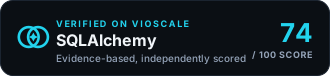
<a href="https://www.vioscale.ai/software/sqlalchemy" target="_blank" rel="noopener">
  <img src="https://www.vioscale.ai/badge/software/sqlalchemy.svg" alt="SQLAlchemy, verified on vioscaleAI" width="330" height="76" loading="lazy" />
</a>
Markdown, for a README →
[](https://www.vioscale.ai/software/sqlalchemy)Claim the profile
Verify you control the domain and you can correct the facts, add the sources we should be reading, and see how AI assistants are describing SQLAlchemy. Free, and it does not change the score.
- Correct anything wrong, with evidence
- Point our crawler at the pages that matter
- See which AI systems are reading this profile
Not the owner? How vendor profiles work