pytest
A Python testing framework that simplifies writing tests and scales to complex testing scenarios
- Vendor
- pytest-dev
- Also known as
- py-test
Available worldwide
What is pytest?
pytest is a Python testing framework designed to make writing simple tests easy while supporting complex functional testing scenarios for applications and libraries. It provides detailed assertion introspection, fixture management, and parametrized test capabilities.
pytest pricing
Plans, per-tier features and add-ons, dated and linked to live pricing. Pricing changes often; always verify at source before you rely on it.
Free and open source. Enterprise support available via Tidelift.
Community (Open Source)
Free- Detailed assertion introspection
- Auto-discovery of test modules
- Modular fixtures
- unittest compatibility
- 1300+ external plugins
Enterprise Support
Contact salesAvailable via Tidelift Subscription for commercial support and maintenance
What pytest does
The capabilities that matter for testing tools, normalised so it lines up with every alternative. “-” means we haven't confirmed it, not that it's missing.
- Test types
- -
- Browser automation
- -
- Built-in assertion library
- ✓
- Languages
- Python
- Mocking / stubbing
- -
- Snapshot testing
- -
- Parallel execution
- -
- Code coverage
- -
- Watch mode
- -
- CI integration
- ✓
Platform & deployment
Independently observed- CLI
- Self-hosted
Security & compliance
Known vulnerabilities: 1 (1 in the last 12 months), max severity MODERATE sourcea count reflects scale & disclosure, not quality
pytest FAQ
Common questions about pytest, answered from independent, dated evidence.
What is pytest and what is it primarily used for?
pytest is a testing framework for Python that enables developers to write simple, readable tests using plain assert statements. It supports everything from basic unit testing to complex functional testing and can automatically discover test files throughout a project directory.
What programming languages does pytest support?
pytest is designed exclusively for Python and requires Python 3.10 or later, or PyPy 3. It does not provide testing support for other programming languages.
What is the license and cost model for pytest?
pytest is open source software distributed under the MIT license and is completely free to use, modify, and distribute. There is no commercial version or paid tier.
What are pytest fixtures and why are they important?
Fixtures are reusable test components that set up preconditions and provide test data through a dependency injection mechanism. They eliminate boilerplate setup and teardown code, improve test clarity by using explicit function parameters, and can be easily parametrized to run tests with multiple data sets.
How does pytest compare to Python's built-in unittest framework?
pytest uses plain Python assert statements instead of unittest's specialized assertion methods like assertEqual(), provides more detailed introspection into failing assertions, and requires less boilerplate code. Both frameworks can coexist in a project, as pytest can run unittest test suites directly.
Can pytest run existing unittest test suites without modification?
Yes, pytest can execute unittest and trial test suites natively without requiring any code changes. This allows teams to adopt pytest incrementally while maintaining compatibility with existing test code.
What is pytest's plugin architecture and how extensible is it?
pytest features a robust plugin system with over 1,300 external plugins available that extend its functionality for CI/CD integration, coverage reporting, parallel execution, and other specialized testing needs. This makes pytest highly customizable for different project requirements.
How does pytest automatically discover and run tests?
pytest follows standard Python naming conventions, automatically locating and running test files named test_*.py or *_test.py, and test functions beginning with test_. This automatic discovery eliminates the need for manual test registration or configuration in most cases.
pytest alternatives
Other testing tools we track, ranked by the same independent score.
- JestJavaScript testing framework with integrated assertions and code coveragemedium · 70%
- PlaywrightCross-browser automation library for building reliable tests and scriptshigh · 77%
- Vitestmedium · 70%
- SeleniumAutomated web browser control for testing and task automationhigh · 77%
- CypressJavaScript testing framework for automated browser testingmedium · 71%
- PuppeteerA JavaScript library for automating and testing web browsersmedium · 68%
Compare pytest
Side by side against other testing tools, attribute by attribute, with a source on every value.
The vioscaleAI score: one lens on the evidence
Not user reviews and not a paid placement: a confidence-weighted blend of the independent signals below (adoption, activity, security posture, and more), which you can sort and re-weight yourself. Vendors can correct their listing but can never move their rank, and stars are weighted low as a vanity metric. It is one way to read the evidence for pytest, not the verdict.
| Signal | Score | Weight | Contribution | Evidence |
|---|---|---|---|---|
| Package downloads | 100 | 0.17 | 17.3 | ✓ |
| Development activity | 63 | 0.12 | 7.6 | ✓ |
| Dependent projects | 91 | 0.08 | 7.3 | ✓ |
| Developer Q&A activity | 80 | 0.08 | 6.4 | ✓ |
| Release cadence | 74 | 0.07 | 5.0 | ✓ |
| Capabilities | 46 | 0.08 | 3.8 | ✓ |
| Security score | 67 | 0.05 | 3.6 | ✓ |
| Stars | 79 | 0.03 | 2.6 | ✓ |
| Integrations | 0 | 0.05 | 0.0 | - |
| Security posture | 0 | 0.09 | 0.0 | - |
Computed . Re-weight it by intent, or see the full method.
All data & sourcesshow ↓
Every value we hold, with its source, retrieval date, and confidence. This is the evidence behind the score: don't trust it, verify it.
Activity
| Attribute | Value | Evidence |
|---|---|---|
| Commits last 30d | 99 | mediumsource · 2026-09-10 · 65% |
Adoption
Content
| Attribute | Value | Evidence |
|---|---|---|
| Faq | 8 items | highsource · 2026-07-30 · 94% |
Features
| Attribute | Value | Evidence |
|---|---|---|
| Capabilities | Languages: Python · Assertions: Yes · Ci integration: Yes | mediumsource · 2026-09-14 · 60% |
Language
| Attribute | Value | Evidence |
|---|---|---|
| Primary | Python | highsource · 2026-09-10 · 98% |
License
| Attribute | Value | Evidence |
|---|---|---|
| Spdx | MIT | highsource · 2026-09-10 · 99% |
Market
| Attribute | Value | Evidence |
|---|---|---|
| Availability | PrimaryMarkets: … · AvailabilityScope: global · AvailableCountries: … · NotAvailableCountries: … | highsource · 2026-08-14 · 75% |
Pricing
Release
Security
Is pytest the right choice for you?
Tell us the job, the constraints and what you weigh most, and we will rank pytest against the rest of the testing tools we index, using the same dated evidence weighted your way.
Free to run, no account needed to start. How the evaluation works
Is this your product?
This profile was built from public sources without asking you. You can take the badge below and use it anywhere, and you can claim the profile to correct anything we got wrong. Both are free, and neither moves pytest up or down: nobody can buy rank here, including you.
Take the badge
Live, always current, and free to use on your own site. It shows pytest's independent score and links back to this profile.
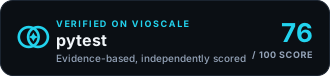
<a href="https://www.vioscale.ai/software/pytest" target="_blank" rel="noopener">
  <img src="https://www.vioscale.ai/badge/software/pytest.svg" alt="pytest, verified on vioscaleAI" width="330" height="76" loading="lazy" />
</a>
Markdown, for a README →
[](https://www.vioscale.ai/software/pytest)Claim the profile
Verify you control the domain and you can correct the facts, add the sources we should be reading, and see how AI assistants are describing pytest. Free, and it does not change the score.
- Correct anything wrong, with evidence
- Point our crawler at the pages that matter
- See which AI systems are reading this profile
Not the owner? How vendor profiles work