Mem0
Memory infrastructure that enables AI agents and applications to retain and recall information across multiple sessions and contexts
- Also known as
- mem0
What is Mem0?
A persistent memory layer designed for AI agents and applications that automatically extracts, stores, and retrieves contextual information. Supports both open-source self-hosted and managed cloud deployment options.
Mem0 pricing
We don't have Mem0's full plan breakdown yet (its pricing page resisted automated reading). Here's what we could confirm. Always check live pricing for exact numbers.
Open source (Apache 2.0 license) with optional managed cloud service
What Mem0 does
The capabilities that matter for agent memory, normalised so it lines up with every alternative. “-” means we haven't confirmed it, not that it's missing.
- Architecture model
- Open source self hosted
- Graph based entity relationship extraction
- ✓
- Automatic context window rolling summarization
- ✓
- Semantic vs episodic event chronological memory
- ✓
- Cross session and multi thread user persistence
- ✓
- Memory conflict resolution and fact updating
- ✓
- Multi tenant user and agent isolation
- ✓
- Native langchain and llamaindex memory classes
- -
- Time decay and recency weighted retrieval
- ✓
- Zero data retention and pii redaction layer
- ✓
- SOC2 type ii
- ✗
- Mit or apache permissive oss license
- ✓
- Pricing model
- Free open source
Platform & deployment
Independently observed- CLI
- Web
- Cloud / SaaS
- Self-hosted
Integrations (18)
Independently observed- Slack
- Claude Code
- Linear
- Zapier
- n8n
- ChatGPT
- Perplexity
- Vercel AI SDK
- DeepSeek
- OpenAI
- HuggingFace
- Cursor
- Windsurf
- Codex
- OpenCode
- OpenClaw
- Claude
- Langgraph
Security & compliance
Independently observed- SOC 2 Type 1 · Type 1active
Mem0 FAQ
Common questions about Mem0, answered from independent, dated evidence.
What is Mem0?
Backend service that stores and retrieves persistent user context for AI agents, automatically condensing chat history to reduce token consumption and latency while maintaining semantic coherence across sessions and multiple integrations. It is indexed under Agent Memory.
Is Mem0 free?
Mem0 offers a free tier, so you can start without paying. Pricing changes often, so verify at source before relying on it.
What platforms does Mem0 support?
Mem0 supports the web and a command-line interface. Platforms we have not confirmed are simply not listed here rather than ruled out.
Can Mem0 be self-hosted?
Yes. Mem0 can be deployed cloud / SaaS, air-gapped and self-hosted, so it does not have to run on the vendor's infrastructure.
What does Mem0 integrate with?
We have confirmed 17 integrations for Mem0, including Slack, Claude Code, Linear, Zapier, n8n, ChatGPT, Perplexity and Vercel AI SDK, plus 9 more. This is what we could verify from public sources, so the vendor may support others we have not indexed.
What security certifications does Mem0 have?
We have independently confirmed SOC 2, HIPAA and GDPR for Mem0. Certifications we do not list are ones we have not been able to verify from public sources, which is not the same as Mem0 not holding them. Always confirm compliance directly before you rely on it.
Mem0 alternatives
Other agent memory we track, ranked by the same independent score.
- CogneeGraph-based memory layer enabling AI agents to retain and recall information across sessionslow · 25%
- SupermemoryA memory engine that enables AI agents to learn and remember across conversations, injecting relevant context into any model in real-time.low · 44%
- ZepA platform that organizes enterprise information into knowledge graphs for AI agentsmedium · 55%
- Mastralow · 44%
- MemaryAn open-source memory system that augments autonomous agents with persistent knowledge graphs to overcome context window limitationslow · 19%
- GraphitiA temporal knowledge graph framework for AI agents that tracks how information evolveslow · 32%
Compare Mem0
Side by side against other agent memory, attribute by attribute, with a source on every value.
The vioscaleAI score: one lens on the evidence
Not user reviews and not a paid placement: a confidence-weighted blend of the independent signals below (adoption, activity, security posture, and more), which you can sort and re-weight yourself. Vendors can correct their listing but can never move their rank, and stars are weighted low as a vanity metric. It is one way to read the evidence for Mem0, not the verdict.
| Signal | Score | Weight | Contribution | Evidence |
|---|---|---|---|---|
| Security posture | 55 | 0.12 | 6.7 | ✓ |
| Capabilities | 96 | 0.04 | 3.6 | ✓ |
| Price level | 80 | 0.04 | 3.3 | ✓ |
| Pricing transparency | 25 | 0.05 | 1.4 | ✓ |
| Integrations | 30 | 0.04 | 1.3 | ✓ |
| Reliability | 0 | 0.07 | 0.0 | - |
Computed . Re-weight it by intent, or see the full method.
All data & sourcesshow ↓
Every value we hold, with its source, retrieval date, and confidence. This is the evidence behind the score: don't trust it, verify it.
Content
| Attribute | Value | Evidence |
|---|---|---|
| Faq | 6 items | mediumsource · 2026-09-10 · 60% |
Features
| Attribute | Value | Evidence |
|---|---|---|
| Capabilities | Soc2 type ii: No · Pricing model: free_open_source · Architecture model: open_source_self_hosted · Mit or apache permissive oss license: Yes · Multi tenant user and agent isolation: Yes · Time decay and recency weighted retrieval: Yes | mediumsource · 2026-10-13 · 60% |
Integrations
| Attribute | Value | Evidence |
|---|---|---|
| Count | 10 | mediumsource · 2026-10-13 · 60% |
Pricing
Security
Is Mem0 the right choice for you?
Tell us the job, the constraints and what you weigh most, and we will rank Mem0 against the rest of the agent memory we index, using the same dated evidence weighted your way.
Free to run, no account needed to start. How the evaluation works
Is this your product?
This profile was built from public sources without asking you. You can take the badge below and use it anywhere, and you can claim the profile to correct anything we got wrong. Both are free, and neither moves Mem0 up or down: nobody can buy rank here, including you.
Take the badge
Live, always current, and free to use on your own site. It shows Mem0's independent score and links back to this profile.
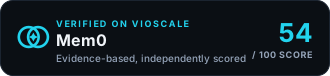
<a href="https://www.vioscale.ai/software/mem0" target="_blank" rel="noopener">
  <img src="https://www.vioscale.ai/badge/software/mem0.svg" alt="Mem0, verified on vioscaleAI" width="330" height="76" loading="lazy" />
</a>
Markdown, for a README →
[](https://www.vioscale.ai/software/mem0)Claim the profile
Verify you control the domain, then point us at the pages that state the facts about Mem0 and add your own description and media. Free, and it does not change the score.
- Correct anything wrong, with evidence
- Point our crawler at the pages that matter
- Write your own description and add media
Not the owner? How vendor profiles work