idna
A Python library for encoding and decoding internationalized domain names
- Vendor
- Pypi
- Also known as
- idna
What is idna?
A Python library that handles internationalized (non-ASCII) domain names by converting between Unicode and ASCII-compatible encoding formats. It provides both a programmatic API and command-line interface for domain name processing.
idna pricing
We don't have idna's full plan breakdown yet (its pricing page resisted automated reading). Here's what we could confirm. Always check live pricing for exact numbers.
Platform & deployment
Independently observed- CLI
Security & compliance
Known vulnerabilities: 2 (1 in the last 12 months), max severity MODERATE sourcea count reflects scale & disclosure, not quality
idna FAQ
Common questions about idna, answered from independent, dated evidence.
What is idna used for?
idna is a Python library for processing and validating internationalized domain names—domain names containing characters from multiple languages and writing systems. It's used in applications to reliably handle encoding, decoding, and validation of these domain names.
Source: https://pypi.org/project/idna/
How does idna compare to Python's standard library?
idna supersedes Python's standard library IDNA implementation by offering broader script coverage and including security vulnerability filtering. This makes it a more comprehensive option for applications requiring robust international domain name handling.
Source: https://pypi.org/project/idna/
Is idna free to use?
Yes, idna is open source software with no licensing fees or usage charges. You can use it freely in any Python project.
Source: https://pypi.org/project/idna/
What is an internationalized domain name?
An internationalized domain name (IDN) is a web address containing characters from non-Latin writing systems—such as Chinese, Arabic, Cyrillic, Greek, or other scripts—allowing users to register and access domains in their native languages.
Source: https://pypi.org/project/idna/
Does idna include security features?
Yes, idna includes security vulnerability filtering as part of its domain name processing. This helps protect applications from security issues that can arise from improper handling of Unicode and international domain names.
Source: https://pypi.org/project/idna/
What platforms does idna support?
idna is a Python library distributed via the Python Package Index (PyPI). It integrates into Python projects on any platform that supports Python.
Source: https://pypi.org/project/idna/
Who should use idna?
Developers building Python applications that work with international domain names should consider idna. It is particularly relevant for services with global audiences or those managing domain operations across multiple languages and regions.
Source: https://pypi.org/project/idna/
idna alternatives
Other utilities we track, ranked by the same independent score.
- charset-normalizerDetects text character encodings when they're unknownlow · 42%
- requestslow · 42%
- yt-dlpCommand-line tool for downloading videos from numerous online platformslow · 27%
- rand_chachaA set of Rust libraries for pseudo-random number generation with multiple algorithms and deterministic seedinglow · 23%
- randlow · 22%
- serdelow · 26%
The vioscaleAI score: one lens on the evidence
Not user reviews and not a paid placement: a confidence-weighted blend of the independent signals below (adoption, activity, security posture, and more), which you can sort and re-weight yourself. Vendors can correct their listing but can never move their rank, and stars are weighted low as a vanity metric. It is one way to read the evidence for idna, not the verdict.
| Signal | Score | Weight | Contribution | Evidence |
|---|---|---|---|---|
| Package downloads | 100 | 0.17 | 17.3 | ✓ |
| Dependent projects | 94 | 0.08 | 7.5 | ✓ |
| Development activity | 55 | 0.12 | 6.6 | ✓ |
| Release cadence | 92 | 0.07 | 6.2 | ✓ |
| Security score | 88 | 0.05 | 4.7 | ✓ |
| Stars | 47 | 0.03 | 1.5 | ✓ |
| Capabilities | 0 | 0.08 | 0.0 | - |
| Integrations | 0 | 0.05 | 0.0 | - |
| Security posture | 5 | 0.09 | 0.0 | - |
| Developer Q&A activity | 0 | 0.08 | 0.0 | - |
Computed . Re-weight it by intent, or see the full method.
All data & sourcesshow ↓
Every value we hold, with its source, retrieval date, and confidence. This is the evidence behind the score: don't trust it, verify it.
Activity
| Attribute | Value | Evidence |
|---|---|---|
| Commits last 30d | 54 | mediumsource · 2026-09-10 · 65% |
Adoption
Content
| Attribute | Value | Evidence |
|---|---|---|
| Faq | 7 items | highsource · 2026-07-30 · 87% |
Language
| Attribute | Value | Evidence |
|---|---|---|
| Primary | Python | highsource · 2026-09-10 · 98% |
License
| Attribute | Value | Evidence |
|---|---|---|
| Spdx | BSD-3-Clause | highsource · 2026-09-10 · 95% |
Pricing
Release
Security
| Attribute | Value | Evidence |
|---|---|---|
| Disclosure policy | Yes | mediumsource · 2026-08-05 · 60% |
| Scorecard | 8.8 | highsource · 2026-09-10 · 90% |
| Vulnerabilities | Count: 2 · Source: https://advisories.ecosyste.ms/api/v1/advisories?ecosystem=pypi&package_name=idna&per_page=100 · Last 12m: 1 · Max severity: MODERATE | highsource · 2026-09-10 · 90% |
Is idna the right choice for you?
Tell us the job, the constraints and what you weigh most, and we will rank idna against the rest of the utilities we index, using the same dated evidence weighted your way.
Free to run, no account needed to start. How the evaluation works
Is this your product?
This profile was built from public sources without asking you. You can take the badge below and use it anywhere, and you can claim the profile to correct anything we got wrong. Both are free, and neither moves idna up or down: nobody can buy rank here, including you.
Take the badge
Live, always current, and free to use on your own site. It shows idna's independent score and links back to this profile.
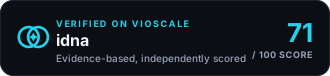
<a href="https://www.vioscale.ai/software/idna" target="_blank" rel="noopener">
  <img src="https://www.vioscale.ai/badge/software/idna.svg" alt="idna, verified on vioscaleAI" width="330" height="76" loading="lazy" />
</a>
Markdown, for a README →
[](https://www.vioscale.ai/software/idna)Claim the profile
Verify you control the domain and you can correct the facts, add the sources we should be reading, and see how AI assistants are describing idna. Free, and it does not change the score.
- Correct anything wrong, with evidence
- Point our crawler at the pages that matter
- See which AI systems are reading this profile
Not the owner? How vendor profiles work