Doccano
A text annotation platform for creating machine learning training datasets
- Also known as
- doccano
What is Doccano?
An open-source tool that enables humans to label text data for machine learning tasks like text classification, sequence labeling, and sequence-to-sequence problems. Users can prepare labeled datasets for applications such as sentiment analysis, named entity recognition, and text summarization.
Doccano pricing
We don't have Doccano's full plan breakdown yet (its pricing page resisted automated reading). Here's what we could confirm. Always check live pricing for exact numbers.
What Doccano does
The capabilities that matter for data labeling, normalised so it lines up with every alternative. “-” means we haven't confirmed it, not that it's missing.
- Model assisted labeling
- -
- Programmatic labeling
- ✓
- Rlhf preference data
- -
- On prem private cloud
- ✓
- Open source
- ✓
- SOC2
- -
Platform & deployment
Independently observed- Web
- Cloud / SaaS
- Self-hosted
Security & compliance
Known vulnerabilities: 0 (0 in the last 12 months) sourcea count reflects scale & disclosure, not quality
Doccano FAQ
Common questions about Doccano, answered from independent, dated evidence.
What is Doccano?
A web-based data labeling tool that enables users to annotate text for machine learning tasks including text classification, sequence labeling, and sequence-to-sequence tasks. Projects can be set up by uploading datasets and working through annotations collaboratively via a browser interface or REST API. It is indexed under Data Labeling.
Is Doccano free to use?
Doccano is open source, so it can be self-hosted and used at no licence cost. It is released under the MIT licence. Pricing changes often, so verify at source before relying on it.
What platforms does Doccano support?
Doccano supports the web and a command-line interface. Platforms we have not confirmed are simply not listed here rather than ruled out.
Can Doccano be self-hosted?
Yes. Doccano can be deployed cloud / SaaS, on-premise and self-hosted, so it does not have to run on the vendor's infrastructure.
Is Doccano open source?
Yes. Doccano is published under the MIT licence, a permissive licence that generally allows commercial use and modification. Licence terms can change between releases, so verify against the repository for the version you intend to use.
Doccano alternatives
Other data labeling we track, ranked by the same independent score.
- Amazon SageMaker Ground Truthmedium · 71%
- iMeritPlatform for AI training data preparation and model evaluationlow · 26%
- Kili TechnologyA collaborative platform for building and managing high-quality training datasets with AI assistancemedium · 73%
- Scale AIEvaluation infrastructure and benchmarking tools for AI modelslow · 45%
- SuperviselyA collaborative data annotation platform for computer vision and machine learning with AI-assisted labeling.medium · 74%
- AppenCurated human-annotated datasets and AI evaluation services for developing advanced AI systemslow · 39%
Compare Doccano
Side by side against other data labeling, attribute by attribute, with a source on every value.
The vioscaleAI score: one lens on the evidence
Not user reviews and not a paid placement: a confidence-weighted blend of the independent signals below (adoption, activity, security posture, and more), which you can sort and re-weight yourself. Vendors can correct their listing but can never move their rank, and stars are weighted low as a vanity metric. It is one way to read the evidence for Doccano, not the verdict.
| Signal | Score | Weight | Contribution | Evidence |
|---|---|---|---|---|
| Release cadence | 94 | 0.08 | 7.7 | ✓ |
| Capabilities | 58 | 0.08 | 4.6 | ✓ |
| Stars | 76 | 0.05 | 3.6 | ✓ |
| Security score | 46 | 0.05 | 2.5 | ✓ |
| Dependent projects | 15 | 0.05 | 0.8 | ✓ |
| Integrations | 0 | 0.05 | 0.0 | ✓ |
| Development activity | 0 | 0.14 | 0.0 | ✓ |
| Security posture | 0 | 0.12 | 0.0 | - |
| Package downloads | 0 | 0.04 | 0.0 | - |
| Developer Q&A activity | 0 | 0.14 | 0.0 | - |
Computed . Re-weight it by intent, or see the full method.
All data & sourcesshow ↓
Every value we hold, with its source, retrieval date, and confidence. This is the evidence behind the score: don't trust it, verify it.
Activity
| Attribute | Value | Evidence |
|---|---|---|
| Commits last 30d | 0 | mediumsource · 2026-08-18 · 65% |
Adoption
Content
| Attribute | Value | Evidence |
|---|---|---|
| Faq | 5 items | mediumsource · 2026-09-10 · 67% |
Features
| Attribute | Value | Evidence |
|---|---|---|
| Capabilities | Open source, On prem private cloud, Programmatic labeling | mediumsource · 2026-10-13 · 60% |
Integrations
| Attribute | Value | Evidence |
|---|---|---|
| Count | 0 | mediumsource · 2026-08-20 · 60% |
Language
| Attribute | Value | Evidence |
|---|---|---|
| Primary | Python | highsource · 2026-10-13 · 90% |
License
| Attribute | Value | Evidence |
|---|---|---|
| Spdx | MIT | highsource · 2026-10-13 · 95% |
Pricing
Release
Security
Is Doccano the right choice for you?
Tell us the job, the constraints and what you weigh most, and we will rank Doccano against the rest of the data labeling we index, using the same dated evidence weighted your way.
Free to run, no account needed to start. How the evaluation works
Is this your product?
This profile was built from public sources without asking you. You can take the badge below and use it anywhere, and you can claim the profile to correct anything we got wrong. Both are free, and neither moves Doccano up or down: nobody can buy rank here, including you.
Take the badge
Live, always current, and free to use on your own site. It shows Doccano's independent score and links back to this profile.
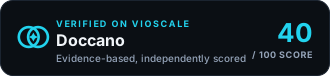
<a href="https://www.vioscale.ai/software/doccano" target="_blank" rel="noopener">
  <img src="https://www.vioscale.ai/badge/software/doccano.svg" alt="Doccano, verified on vioscaleAI" width="330" height="76" loading="lazy" />
</a>
Markdown, for a README →
[](https://www.vioscale.ai/software/doccano)Claim the profile
Verify you control the domain, then point us at the pages that state the facts about Doccano and add your own description and media. Free, and it does not change the score.
- Correct anything wrong, with evidence
- Point our crawler at the pages that matter
- Write your own description and add media
Not the owner? How vendor profiles work